
2026-03-04 Newsheadline
By Qi Chenjiong
In a modest stone carving workshop in Zhengchang Village, Xun County, Henan Province, young artisan Zhang Jingpeng is breathing new life into an ancient tradition. Crouched over his workbench, sandpaper in hand, the third-generation stonemason meticulously polishes a piece of local bluestone, gradually transforming raw material into art.
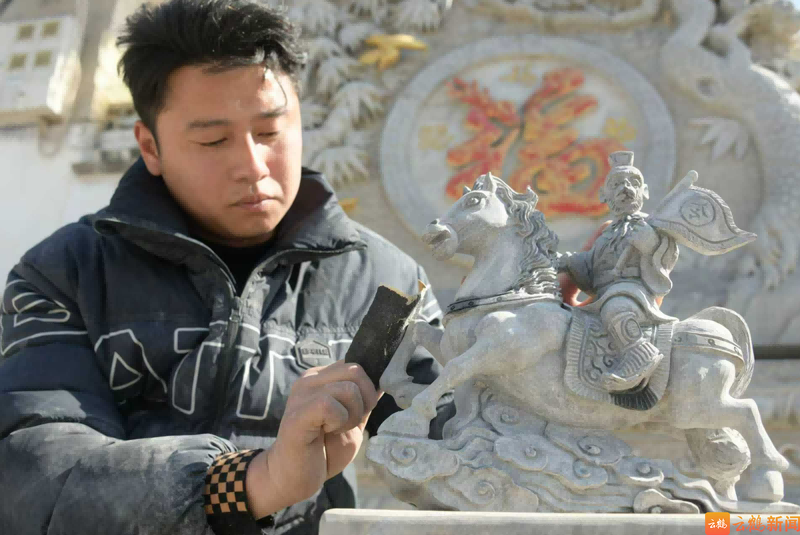
The work in progress, titled "Ma Shang Feng Hou" (Immediate Ennoblement), represents more than ten days of intensive labor. As chisel marks fade and the stone's natural warmth emerges, the sculpture captures a horse rearing skyward, hooves treading upon clouds, with a monkey in armor holding a command flag—a traditional symbol of career success and rapid advancement.
Xun County, designated a national historical and cultural city and recognized as a home of Chinese folk art, has nurtured stone carving traditions for millennia. Tunzi Town, in particular, has earned the title "Hometown of Stone Carving" through its exquisite craftsmanship and distinctive artistic style.
For Zhang, the craft is literally in his blood. His grandfather and father were both renowned master stonemasons; their family workshop has produced stone tablets, pavilions, statues, and archways for generations. The rhythmic sound of chisel against stone has echoed through their household for decades.
Yet Zhang represents a new generation of artisans who are reshaping the industry's future. While his predecessors relied on word-of-mouth and local networks to find clients, the 2025 landscape demands new approaches.
"The older generation depended on reputation and personal connections," Zhang explained. "Now we want the stones themselves to speak to people and showcase the charm of Tunzi carving to a wider audience."
This year, Zhang embraced digital platforms, launching accounts on Douyin (Chinese version of TikTok) and WeChat Channels. Through short videos documenting his carving process and highlighting intricate details, he has attracted a substantial online following and converted viewers into customers from across China.
"In the coming year, I hope to use these platforms to help more people discover Tunzi stone carving and purchase works from our village," Zhang said. "I know one person's efforts may seem small, but I want to contribute whatever I can to preserving and developing my hometown's heritage."
Zhang is not alone. Throughout Tunzi Town, young artisans are emerging, using bluestone as their medium and innovation as their tool. By honoring tradition while embracing modern methods, they are ensuring this millennium-old craft remains vibrant and relevant.
Their efforts are injecting fresh vitality into the cultural heritage of China's Central Plains, demonstrating that ancient arts can thrive in the modern era when supported by dedicated practitioners willing to adapt and evolve.
Wildfires burning across Europe are setting off old WWI and WWII bombs
Green Electricity Illuminates Indoor Ski Resort in Central China
The Raefel team announced global recruitment, marking a major strategic upgrade to the SJPF investment research system.
INLIGHT: Bringing a Thousand-Year Lantern Heritage to the World
CURENTA Golf Cart Battery: Built So Every Cart Never Bogs Down
9 PEOPLE BUILT A $10 BILLION DOLLAR ECOSYSTEM IN ONE YEAR
©copyright 2009-2020 Singapore Info Map
