

QINGDAO,China,Dec. 19,2024 -- China Petroleum & Chemical Corporation's (HKG: 0386,"Sinopec") completes China's first factory-based seawater hydrogen production research project at its Qingdao Refinery. The project integrates direct seawater electrolysis with renewable energy-powered green hydrogen production,achieving an hourly output of 20 cubic meters of green hydrogen. This innovative approach not only offers a new solution for coastal regions to utilize renewable energy for green hydrogen production but also provides an alternative pathway for the resourceful utilization of high-salinity industrial wastewater.
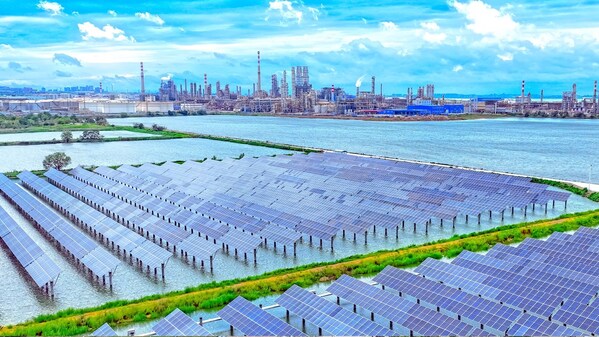
China’s First Factory-Based Seawater Hydrogen Production Project Completed at Sinopec Qingdao Refinery.
The project adopts a factory-based operation model,leveraging part of the green electricity generated from Qingdao Refinery's floating photovoltaic power station. Through electrolysis,seawater is split into hydrogen and oxygen,with the produced hydrogen seamlessly integrated into the Qingdao Refinery's pipeline network for use in refining processes or hydrogen-powered vehicles. The entire production process occurs within a factory setting,ensuring efficiency and operational stability.
Seawater hydrogen production holds significant potential. By directly converting seawater into hydrogen,unstable and hard-to-store renewable energy can be transformed into green hydrogen,which is relatively easier to store and utilize. Moreover,this process conserves precious freshwater resources,offering a new pathway for the development of the hydrogen energy industry.
Despite its advantages,seawater hydrogen production comes with challenges. Seawater contains approximately 3% salt,and impurities,such as chloride ions,can corrode electrolytic electrodes,while cation deposits may clog equipment channels,reducing efficiency and causing damage. Sinopec Qingdao Refinery,in collaboration with the Dalian Institute of Petroleum and Petrochemicals,has successfully overcome these challenges through a series of specialized equipment innovations and unique process designs,including chlorine-resistant electrode technology,high-performance electrode plate design,and a seawater circulation system,enabling a seamless integration of research and practical applications.
Seawater hydrogen production is expected to achieve large-scale industrial applications in the future. Sinopec is accelerating its efforts to become China's leading hydrogen energy company by advancing the research and application of hydrogen technologies across the entire industry chain.
Sinopec has already achieved several milestones,including the successful deployment of a megawatt-scale PEM electrolyzer and the commissioning of China's first 100-kilowatt Solid Oxide Electrolysis Cell (SOEC) project. By 2024,the company has established 136 hydrogen refueling stations,and built 11 hydrogen fuel supply centers,underscoring its commitment to driving high-quality growth in the hydrogen energy sector.
Inside the Air India crash simulation that ‘casts doubt on pilot suicide theory’
Fighter jets scrambled to shoot down drone that entered Nato airspace
More than 100 people leap from blazing boat as fire engulfs children’s tour
The ‘brown challenge’ is spreading across Spain – and it’s seriously disgusting
Local councillor wants to hold a swingers party in his town hall
Explosion at Rotterdam port leaves one dead and several injured
©copyright 2009-2020 Singapore Info Map
