
2024-08-27 Xi'an Jiaotong-Liverpool University HaiPress
A new study sheds light on the origin of low-frequency space-time ripples
SUZHOU,China,Aug. 21,2024 -- Similar to the ripples produced from dropping a stone in water,the collision of large celestial objects,such as black holes,generates gravitational waves – ripples in the fabric of space-time.
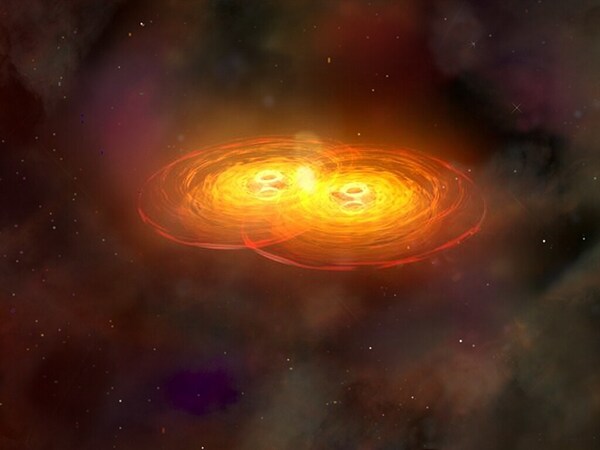
This illustration shows a stage in the merger of two galaxies that forms a single galaxy with two centrally located supermassive black holes surrounded by disks of hot gas. The black holes orbit each other for hundreds of millions of years before they merge to form a single supermassive black hole that sends out intense gravitational waves. Credit: NASA/CXC/A.Hobart,Public domain,via Wikimedia Commons
A specific type,nanohertz gravitational waves,was identified in 2023. These waves have such a low frequency that it took scientists over 10 years to see a complete cycle. However,how these waves are generated is still unclear.
Some scientists thought they came from a first-order phase transition – a change in the universe's structure as it expands and cools down. Yet a new study published in Physical Review Letterschallenges that theory.
Dr Andrew Fowlie,Assistant Professor at Xi'an Jiaotong-Liverpool University(XJTLU),and an author of the paper,says: "Theorists and experimentalists have speculated nanohertz gravitational waves originated from a known transition that happened very soon after the big bang – a change that generated the masses of all the known fundamental particles.
"However,our work uncovers serious problems with that otherwise appealing explanation of their origin."
"We found that to have created waves with such tiny frequencies,the transition would have to be supercool," says Dr Fowlie.
We can understand supercooled transitions by thinking about ice and water. We all know that water changes to ice as temperature cools below freezing. Water may,however,become stuck in the liquid phase,even below the freezing point,slowing down the transition to ice.
However,DrFowlie explains why his research team believes nanohertz gravitational waves are not produced by supercooled first-order phase transitions. "These slow transitions would struggle to finish,as the transition rate is slower than the cosmic expansion rate of the universe.
He says,"What if the transition sped up at the end? We calculated that even if this helped the transition to end,it would shift the frequency of the waves away from nanohertz.
"Thus,although nanohertz gravitational waves are cool,they are probably not supercool in origin.
"If these gravitational waves do come from first-order phase transitions,we now know that there must be some new,much richer physics going on – physics we don't know about yet.
"Understanding this field will help us understand the most fundamental questions about the origin of the universe."
The study can be read here.
Wildfires burning across Europe are setting off old WWI and WWII bombs
Green Electricity Illuminates Indoor Ski Resort in Central China
The Raefel team announced global recruitment, marking a major strategic upgrade to the SJPF investment research system.
INLIGHT: Bringing a Thousand-Year Lantern Heritage to the World
CURENTA Golf Cart Battery: Built So Every Cart Never Bogs Down
9 PEOPLE BUILT A $10 BILLION DOLLAR ECOSYSTEM IN ONE YEAR
©copyright 2009-2020 Singapore Info Map
